Implementation reference
Amazon EDI 856: validate the shipment, not only the syntax
On this page
An EDI 856 is the Advance Ship Notice that tells a receiving system what is moving, how it is packed, which purchase orders and items it contains, and which identifiers connect the electronic notice to the physical cartons or pallets.
Direct answer: An Amazon Vendor 856 should pass three different gates before submission: a valid X12 envelope, a coherent Shipment–Order–Tare–Pack–Item hierarchy, and reconciliation between the ASN, accepted PO, warehouse pack output, labels, and transport documents. A file that merely parses can still describe the wrong shipment.
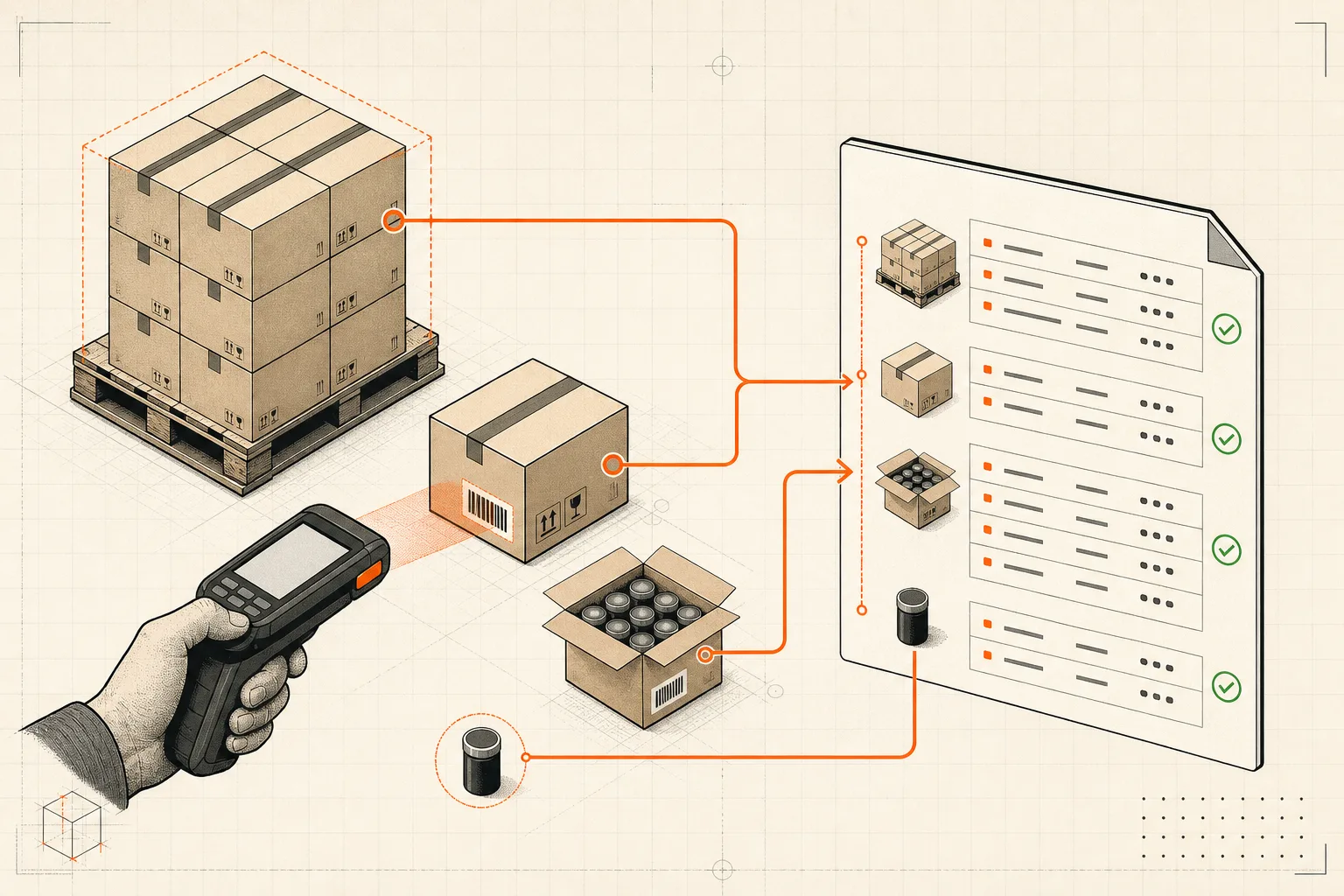

What the Amazon 856 needs to prove
The interchange and transaction controls must agree. ISA13 must match IEA02, GS06 must match GE02, ST02 must match SE02, IEA01 must reflect the number of functional groups, and SE01 must count every segment from ST through SE inclusively. These are deterministic defects; they should never survive into partner testing.
The detail loops then need to describe a real shipment without ambiguity:
- The first HL loop is the shipment root.
- Every later HL02 points to an earlier HL01.
- Purchase-order data appears at the level required by the current account guide.
- Pack and item loops remain connected to the correct PO.
- Container identifiers in MAN or the API payload match the printed logistics labels.
- Quantities, units, dates, BOL, PRO, ARN, carrier, and shipment type agree with the operational source records.
Amazon’s current Submit shipment confirmation tutorial is API-shaped, but it exposes several current business requirements that also matter to an EDI workflow: send the confirmation before receipt, separate materially different shipments, supply shipment-type references, and keep physical SSCC barcodes synchronized with the confirmation.
SOPI, SOTI, and SOTPI hierarchy profiles
The letters name the detail levels: Shipment, Order, Tare, Pack, and Item. Common shapes include SOPI for loose cartons, SOTI for pallet-to-item detail, and SOTPI when both pallet and carton relationships must be represented. They are not interchangeable formatting preferences. The hierarchy must preserve the physical and commercial relationships expected by the trading partner.

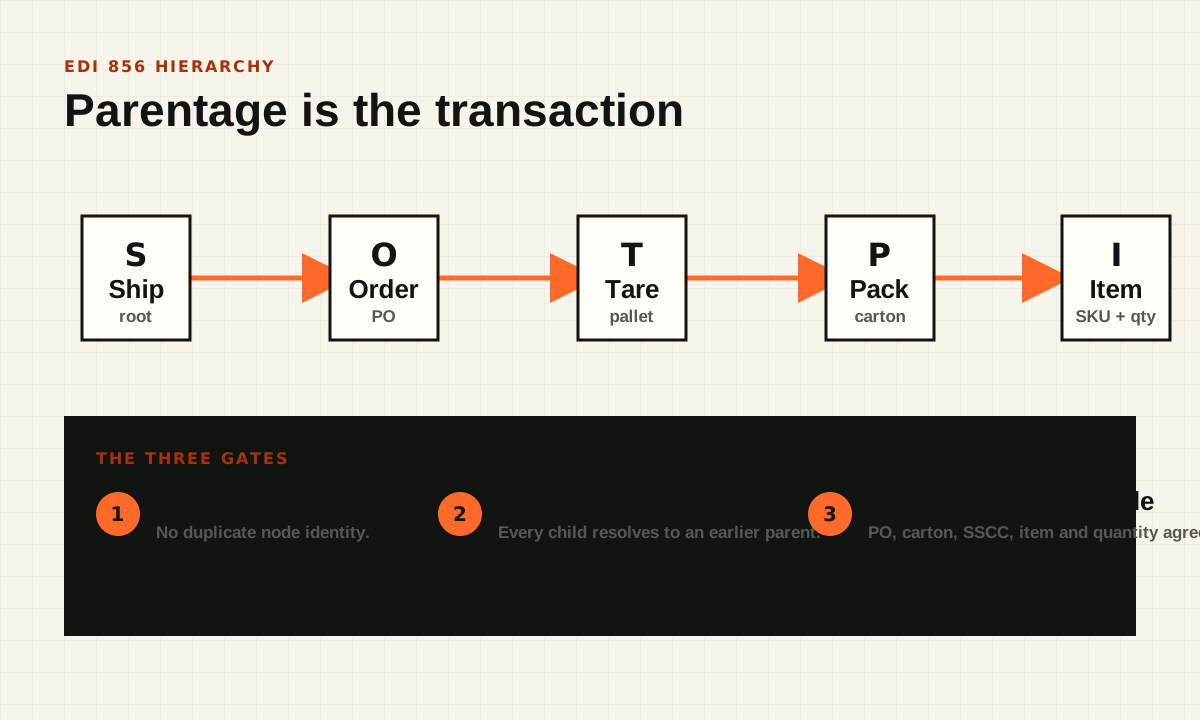
HL*1**S~       Shipment
HL*2*1*O~      └─ Purchase order
HL*3*2*T~         └─ Pallet / tare
HL*4*3*P~            └─ Carton / pack
HL*5*4*I~               └─ Item
The sequence S,O,T,P,I is only a quick profile signal. Parent references are the truth. Duplicate HL01 values, missing parents, forward parents, and items connected to the wrong order can all produce a plausible-looking sequence that is still invalid.
The segments operators inspect first
| Segment | Operational purpose | Typical preflight question |
|---|---|---|
| BSN | Notice purpose, shipment ID, creation date/time, hierarchy code | Is this original/replacement identity intentional? |
| HL | Parent-child packing hierarchy | Does every child point to the correct earlier parent? |
| TD1 / TD5 | Packaging, weight, carrier, routing | Do units and carrier references match dispatch records? |
| REF / DTM | Shipment references and dates | Are BOL, PRO, ARN, pickup, and arrival values present where required? |
| PRF | Purchase-order reference | Does each shipped item remain tied to the accepted PO? |
| MAN | Carton/pallet identifier, commonly SSCC | Does the transmitted value exactly match a label scan? |
| LIN / SN1 | Item identity and shipped quantity | Do SKU/UPC and quantity agree with actual pack output? |
The complete EDI 856 segment reference includes valid and invalid examples and links each segment back to the free checker.
A valid syntax result is not Amazon acceptance
Passing envelope and hierarchy checks means the document is internally coherent. It does not prove that Amazon will accept it or that receiving will observe the same cartons, quantities, and identifiers. Current Vendor Central documentation and your account’s implementation guide remain controlling.

Shipment Sentry deliberately labels each finding by evidence class:
- X12 base: deterministic structure, controls, counts, and hierarchy integrity.
- Current Amazon: supported by current public Amazon developer or vendor material.
- GS1: identifier structure and check-digit rules.
- Account-specific: a warning that must be checked against the current partner guide.
That distinction prevents a generic validator from presenting a retailer-specific assumption as universal X12 truth.
Preflight workflow before dispatch
- Parse and validate the exact outbound bytes—not a convenient preview generated earlier.
- Correct envelope and control failures first.
- Correct HL hierarchy and required identifier failures second.
- Reconcile PO lines, quantities, cartons/pallets, and units with warehouse output.
- Scan printed SSCC labels and compare the decoded values to MAN/API identifiers.
- Compare BOL, PRO, ARN, carrier, and dates with transport documents.
- Re-run the preflight and retain the result hash, rule-pack version, and operator decision.
Frequently asked questions
Does a valid 856 guarantee Amazon will accept it?
No. It removes provable structural and public-rule defects. Account-specific requirements, submission timing, duplicate/replacement behavior, and the physical shipment can still cause rejection or receiving discrepancies.
Does Shipment Sentry transmit an ASN to Amazon?
Running the public validator checks a payload; it does not submit that payload to Amazon. Transmission is a separate configured workflow through your VAN, EDI provider, Vendor Central process, or authorized SP-API integration. Confirm the active route's delivery capability and receipt evidence before treating a generated or validated file as sent.
Which X12 version is supported?
The parser is delimiter-driven and the validator targets common 4010-era 856 structure. Partner-specific version and usage rules remain separate, visible evidence classes rather than hidden assumptions.
Choose the correct Amazon program and interface
Start onboarding by identifying the commercial relationship and shipment program. Amazon Vendor retail procurement, direct fulfillment, and seller fulfillment workflows do not share one universal shipment interface. A guide or sample for one program can be irrelevant to another. Record the account, marketplace, receiver identity, document version, transport channel, and shipment types before treating any example as an implementation specification.
The shipment-confirmation API documentation is useful for understanding its own contract. It does not replace an X12 implementation guide. If a business uses both an API and EDI, document which system owns each submission and how duplicate business notices are prevented. Two interfaces describing the same physical shipment need an intentional operating policy, not independent automations that both send whenever a warehouse export appears.
Ask the integration owner for a current successful test artifact, the applicable guide revision, and the latest rejection examples. These give the mapping team concrete evidence of the expected format. Keep confidential partner documentation inside the authorized workspace. Public educational content can explain principles and public requirements without reproducing account-specific material or implying that every account follows the same rule.
Turn an Amazon EDI 856 specification into a mapping contract
A practical mapping contract describes each business fact before naming its target segment. For the shipment identifier, state which system allocates it, when it becomes immutable, and how corrections relate to the original. For a purchase order, state which accepted revision is authoritative. For item quantities, identify whether the source contains eaches, cases, or another agreed unit and where any conversion factor comes from.
Then record the target location, qualifier, format, condition, and failure behavior. A missing required reference should stop the relevant output or create an explicit exception. It should not be replaced with a convenient placeholder. Defaults are appropriate only when the partner contract defines a legitimate constant and the team can explain why it applies to every affected record.
Keep mapping versions separate from partner profile versions. A partner can update its guide while the source warehouse export remains unchanged; the source can change a column name while the partner format stays fixed. Recording both versions lets support reproduce an earlier output and identify which change introduced a defect. See the EDI conversion guide for preview and fixture requirements.
Reconcile purchase orders and partial shipments
An ASN should describe what shipped, while an order represents what was requested or accepted. Compare those records without forcing them to be identical. If an accepted order contains twenty units and the warehouse dispatches twelve, the ASN should preserve twelve shipped units. The remaining quantity needs an explicit business state under the applicable order process. Inflating the ASN to twenty hides the shortage until receiving.

Reconciliation needs stable line identity, not only a product description. The same item can appear on more than one order line with different dates, destinations, or commercial terms. Match the customer reference and item crosswalk at the right scope. Where the source cannot resolve an allocation uniquely, hold the ambiguous line for review instead of distributing quantities arbitrarily.
For repeated shipments against one order, maintain cumulative quantities and deduplicate retransmissions. A corrected notice must not count as another physical shipment simply because its filename changed. Preserve the shipment identity, prior version, correction reason, and resulting effect on the cumulative balance. This is a core requirement for a full EDI solution because it connects document processing with an accurate operational history.
Match labels to the exact logistics units in the ASN
The warehouse label and electronic notice must identify the same physical unit. Validate the SSCC's mathematical structure, then scan a printed label and compare its decoded value with the outbound container record. A correct check digit alone does not prove that the label belongs to the right carton or pallet. The physical association is a separate check that requires warehouse evidence.

Avoid using AI-generated label artwork as a print template. Illustrations can explain placement and scanning, but production labels need deterministic barcode generation, controlled identifiers, suitable dimensions, and verification under the applicable requirements. The SSCC barcode generator explains how the identifier, GS1 application identifier, barcode symbol, and human-readable text fit together.
When cartons are repacked after an ASN preview, regenerate the affected electronic relationships and labels according to the operating procedure. Keep a clear cutoff between editable packing work and a released shipment artifact. Otherwise a valid file can become inaccurate before dispatch because the physical shipment changed after validation.
Keep small parcel, LTL, and truckload evidence distinct
Different shipment types can require different transport references and container relationships. A tracking number, bill of lading, carrier reference, and routing reference serve different purposes. Do not populate every transport field with the only number available in the source export. The route configuration should define which evidence is required for each supported shipment type.
Build test fixtures for the shipment types the account actually uses. A successful small-parcel fixture does not establish that a palletized truckload mapping is correct. Include the expected packing hierarchy and transport references in the fixture review. If a required field is supplied by a carrier integration after packing, represent that dependency explicitly so output cannot be released prematurely.
Dates also have distinct meanings: notice creation, shipment departure, expected arrival, and requested delivery are not interchangeable. Preserve timezone and source precision. An export containing only a date should not silently become a precise midnight event unless the target contract permits that interpretation. Explain any required transformation and verify it against the partner's current field definitions.
Test onboarding with failures as well as successful samples
Begin with a minimal valid fixture for the exact profile. Add multi-carton, mixed-item, partial-shipment, and correction cases where supported. Then deliberately remove a required reference, change a container check digit, attach an item to the wrong parent, and alter a trailer count. Each failure should produce an understandable finding at the relevant location. A test that only proves the tool accepts one file gives little confidence about real operating errors.
Partner testing adds evidence that local validation cannot supply. Record which account and program were tested, the guide version, the submitted artifact hash, the response, and any limitations. A successful test should not be generalized to unrelated retailers or every future guide revision. Retest the affected fixtures when the mapping, profile, serializer, or source export changes.
Keep the final emitted bytes, not just a rendered preview. Transport code can change encoding, line endings, or filenames after validation. The released artifact should be the one that passed the relevant checks. Its hash connects the validation result, delivery request, and subsequent acknowledgment to a reproducible piece of evidence.
Expand retailer coverage through explicit partner profiles
People searching for Walmart EDI 856, Walgreens ASN requirements, Costco EDI, or Woolworths EDI are often solving the same operational problem: connecting an order and a physical shipment to a retailer's receiving system. That shared problem supports reusable ingestion, mapping, validation, and monitoring components. It does not make the retailers' document requirements identical.
Create a separate profile for each retailer, program, version, and direction that the product supports. The profile should identify the current source, required identifiers, permitted hierarchy, transport expectations, and onboarding status. Distinguish public reference coverage from account-configured and partner-tested behavior. A retailer logo or a generic X12 parser is not sufficient evidence of a working connection.
For Walmart, first identify the supplier program and the applicable connection requirements. For Walgreens or Costco, obtain the current authorized implementation material and testing process. For Woolworths, identify the actual country and business entity before choosing a standard family or profile. The shared name can conceal different organizations and technical requirements. Use those distinctions to create focused onboarding paths rather than pages that swap retailer names in an Amazon template.
When a retailer uses EDIFACT DESADV, select a dedicated parser and profile rather than translating X12 segment labels mechanically. The DESADV guide explains the separate syntax and version controls. Shared business reconciliation can still compare orders, quantities, and logistics units after each format has been interpreted correctly.
Decide what belongs in a full EDI platform
Validation is one step in a larger workflow. A complete route also needs durable intake, approved mapping, output generation, delivery evidence, acknowledgment correlation, exception ownership, and recovery. Where an ERP is involved, the system must confirm the intended application outcome and prevent duplicate writes. Each of these stages needs its own observable status so an operator can see where work stopped.

Evaluate an EDI solution using a real scenario: receive an order, acknowledge it, ship part of it in multiple cartons, generate the ASN, process a rejection, correct the source, and reconcile the final outcome. Ask the product to demonstrate the exact supported operations rather than presenting a long transaction-name list. The transaction-set guide connects the 850, 855, 856, 810, and inventory workflows.
Full platform coverage should grow from repeatable tested routes. Preserve the broad architecture while being precise about which partner connections are configured and operational. This lets a business expand from Amazon to additional retailers without losing the evidence, mappings, and exception history already accumulated.
Additional Amazon ASN questions
Why does Amazon reject an ASN that passed my translator?
The translator may have checked syntax while the rejection concerns account-specific business rules or mismatched source data. Identify the exact processing stage and response. Compare the rejected transaction with the current guide, order records, packing allocations, and transport references. A technically readable file can still describe an unknown order or the wrong shipment.
Can I use one ASN template for every retailer?
You can reuse a normalized shipment model and parts of the mapping engine, but each receiver needs an explicit target profile. Required fields, hierarchy, identifiers, versions, and response expectations can differ. Treat a reusable template as a starting structure whose partner-specific rules must be reviewed and tested.
What should I ask an LLM when debugging an Amazon EDI file?
Ask a narrow question using redacted evidence, such as which parent relationship appears inconsistent or which source fields are needed to explain a quantity mismatch. Require the answer to distinguish observed facts from assumptions. Verify suggested changes against the current profile and deterministic tests before generating a corrected operational document.
Where should I look for Amazon EDI documentation and ASN requirements?
Use the current material for your account, program, marketplace, and interface. Public developer documentation explains the API contract it names; it should not be treated as an account-specific X12 guide. Keep the relevant revision and approved test evidence in the partner profile. When investigating Amazon ASN errors, record which source supports the proposed correction and whether the finding concerns syntax, business data, or physical receiving. This makes later changes reviewable and prevents an old onboarding note from becoming an unexamined rule for every shipment.
Primary sources
Apply the current standard, profile, and trading-partner requirements for your workflow. Each result establishes only the checks it explicitly reports.